
NordForsk is an organisation under the Nordic Council of Ministers that provides funding for and facilitates Nordic cooperation on research and research infrastructure.
The current initiative is based on the rapid advancement of artificial intelligence technologies, whose applications are emerging in ways that are difficult to predict. The programme aims to promote the ethical and responsible use of AI.
The project – AI for Mindful Care and Ageing (AMICA): Navigating vulnerability in the use and implementation of automated home care – is a Nordic–Baltic collaboration involving researchers from Lund University, University of Eastern Finland, Tallinn University of Technology and Norwegian University of Science and Technology. The project is led by Wenqian Xu, postdoctoral fellow within Lund University’s profile area Proactive Ageing.
What new insights do you hope the project will add about older adults’ lives in a digitalised care environment?

“I hope that with this project, our team will generate policy-oriented scientific knowledge about how AI-driven automation shapes older adults’ care experiences, care labour, inequality, and welfare systems. The project will use a critical and analytical framework of “vulnerability intersections” to examine and better understand how AI might perpetuate or create inequalities and human vulnerabilities even when it is designed to reduce these, by bringing in perspectives of diverse stakeholders such as older adults, caregivers, and industry.”, Wenqian Xu, postdoctoral fellow within Lund University’s profile area Proactive Ageing.
In what ways can AI-automated home care strengthen older adults’ independence and quality of life?
“From a scientific point of view, my scoping review shows that such adoption can be associated with positive outcomes, such as reduced loneliness and social isolation, increased perceived social support, and delayed institutionalisation. These benefits stem from daily companionship, health monitoring, personalised care planning, better care coordination, and improved service accessibility.”
How do you think the results can help municipalities and care organisations implement AI in a safer and more considerate way?
“The project will draw on policy analysis, industry insights, and lived-experience narratives to produce evidence-based suggestions for municipalities and care providers. Specifically, I think the project findings will help organisations identify structural risks and gaps in current AI governance, mitigate and prevent harm from poorly designed or implemented technologies particularly on the experiences of vulnerable groups, as well as support care workforce preparedness. To achieve this, we will conduct a wide range of dissemination and exchange formats enabling the project to maximise policy impact, reach wider publics beyond the immediate stakeholders involved, and increase the visibility of Nordic-Baltic perspectives at the European level.”
Wenqian Xu also adds that the project will strengthen regional research capacity and leadership by nurturing the next generation of scientific leaders to tackle the societal challenges of AI in care and ageing. In particular, the project will support early-career researchers through interdisciplinary doctoral training, mentoring and researcher mobility.
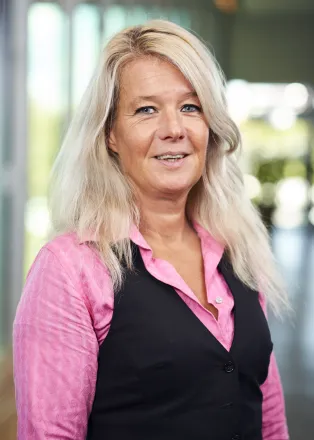
Susanne Frennert is the co-PI of the project and an associate professor (docent) at the Division of Ergonomics and Aerosol Technology, Department of Design Sciences, LTH, Lund University. With a background in human factors and ergonomics, her research focuses on the societal consequences of digitalisation and how technology transforms and affects the lives of people. Reflecting on the project, Frennert says that what excites her most is the collaborative set-up:
“For me, the real strength of this project is the team and the Nordic–Baltic collaboration. Already when we were drafting the proposal, I could see how our different perspectives and insights made the application stronger. My hope is that this cross-border collaboration will result in truly impactful and interesting research.”
Drawing on her experience from several EU projects, she adds: “Again and again, I have seen that it is the quality of the team and the way we work together that decides whether a project leads to excellent research. That is exactly what I see coming together in this NordForsk project”